Is Your Leadership Style Helping or Hindering Your Team?
Most leaders don’t set out to silence their teams. They want collaboration. They encourage innovation. They talk about empowering people and creating high-performing teams. Yet, without realising it, many leaders unintentionally create environments where their opinion carries so much weight that it overshadows everyone else’s.
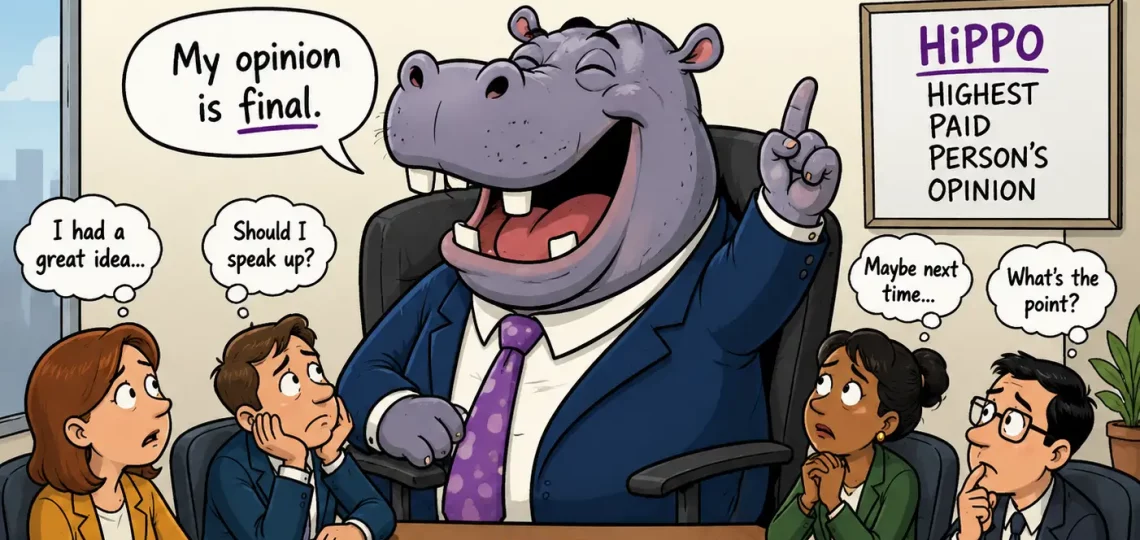
This phenomenon is known as the HiPPO effect—the Highest Paid Person’s Opinion.
The term is commonly used to describe situations where decisions are driven primarily by the views of the most senior or highest-paid person in the room, rather than by evidence, expertise, or collaborative discussion. While senior leaders naturally bring valuable experience, organisations pay a significant price when hierarchy consistently outweighs curiosity.
At Novista Coaching, we’ve seen how even well-intentioned leaders can fall into this trap. The consequences extend far beyond individual meetings. HiPPO behaviours shape culture, influence engagement, suppress innovation and ultimately affect business performance.
The encouraging news is that HiPPO leadership isn’t a permanent leadership style. With greater self-awareness and intentional leadership development, it can be replaced by a culture where people feel empowered to think, contribute and challenge constructively.
What Is HiPPO Leadership?
HiPPO leadership isn’t simply about making decisions.
Senior leaders are expected to make difficult choices, often with incomplete information. The problem arises when the leader’s opinion becomes the decision before meaningful discussion has even begun. Imagine a strategy meeting where several options are being explored. As soon as the director says:
“I think we should go with Option A.”
The conversation changes, alternative ideas receive less attention and, questions become confirmations. People begin searching for reasons why the leader must be right rather than evaluating all available evidence objectively. This isn’t always intentional. In fact, the strongest personalities are often completely unaware they’re influencing the discussion simply by speaking first.
Why Does HiPPO Behaviour Happen?
HiPPO behaviour usually develops because of organisational dynamics rather than personality alone. Several factors contribute:
Leaders feel pressure to have the answers
Many senior leaders believe their role requires certainty. Admitting uncertainty can feel uncomfortable, particularly in organisations that reward confidence over curiosity.
Experience creates confidence
Years of success naturally build confidence.While confidence is valuable, it can unintentionally reduce curiosity. Leaders begin trusting instinct over inquiry.
Teams defer to authority
Employees quickly learn whose opinion matters most. Even when invited to contribute, many people self-censor because previous experience has taught them that challenging senior leaders carries risk.
Time pressure encourages shortcuts
When deadlines loom, leaders often make quick decisions. Unfortunately, speed achieved by bypassing discussion often leads to slower implementation, poorer buy-in and missed opportunities later.
The Impact of HiPPO Leadership on Individuals
The first casualty of HiPPO leadership is often psychological safety. Psychological safety exists when people feel comfortable expressing ideas, asking questions, admitting mistakes and respectfully disagreeing without fear of embarrassment or punishment. Without psychological safety, people begin protecting themselves.
Instead of asking: “How can I contribute?”
They begin asking: “What’s the safest thing to say?”
Over time this changes behaviour dramatically. Employees become less likely to:
- Challenge assumptions
- Offer creative ideas
- Raise concerns early
- Admit uncertainty
- Share lessons from failure
- Provide honest feedback
Eventually, many simply stop contributing altogether. This creates compliance rather than commitment. People may appear engaged because meetings are harmonious, but beneath the surface they have disengaged intellectually. The organisation loses access to its greatest resource: the collective intelligence of its people.
The Impact on Team Performance
HiPPO leadership doesn’t just affect individuals. It fundamentally changes how teams operate.
Innovation Declines
Innovation depends on diverse perspectives. The best ideas rarely emerge fully formed from one individual. Instead, they evolve through discussion, challenge and refinement. When one opinion consistently dominates, creativity narrows. Teams stop exploring possibilities because they assume the destination has already been decided.
Groupthink Becomes Normal
Healthy disagreement is essential for effective decision-making. HiPPO cultures unintentionally reward agreement. People begin reinforcing existing assumptions rather than testing them.
As a result:
- Risks go unnoticed.
- Blind spots increase.
- Poor decisions survive longer.
- Opportunities are missed.
Ironically, the leader receives less accurate information precisely because people want to support them.
Accountability Weakens
People naturally support what they help create. When decisions are imposed rather than developed collaboratively, ownership decreases. Employees may complete the task because they have been instructed to. They are less likely to invest discretionary effort in making it successful.
Learning Slows Down
High-performing organisations learn continuously. Mistakes become opportunities for improvement rather than sources of blame. In HiPPO environments, people become reluctant to discuss failures openly.
The result?
The same mistakes repeat because nobody feels safe enough to examine them honestly.
The Hidden Organisational Costs
Many leaders assume HiPPO behaviour saves time. It often appears to. Meetings end quickly, decisions are made rapidly. However, the hidden costs usually outweigh the perceived efficiency.
These costs include:
- Lower employee engagement
- Increased staff turnover
- Reduced innovation
- Poorer decision quality
- Slower organisational learning
- Reduced adaptability
- Lower trust in leadership
- Increased resistance to change
Perhaps the greatest cost is invisible. Employees stop bringing their best thinking to work. They still complete tasks. They still attend meetings. But their creativity, initiative and passion gradually disappear.
Signs You May Be Displaying HiPPO Behaviours
Leadership requires honest self-reflection.
Ask yourself:
- Do people usually agree with me immediately?
- Am I speaking before others have shared their ideas?
- Do meetings become quieter after I express my opinion?
- How often do people challenge my thinking?
- When was the last time someone completely changed my mind?
If those questions feel uncomfortable, that’s often where growth begins. The strongest leaders actively seek evidence that contradicts their assumptions.
Moving Beyond HiPPO Leadership
Transforming leadership begins with changing conversations. Here are several practical approaches.
Speak Last
One of the simplest leadership habits is also one of the most powerful.
Allow others to contribute before offering your own perspective. Doing so dramatically increases the diversity of ideas shared.
Replace Answers with Questions
Instead of saying: “Here’s what I think.”
Try asking:
- What are we missing?
- Who sees this differently?
- What evidence supports this recommendation?
- What’s the biggest risk we’re overlooking?
- If we couldn’t choose this option, what else might we do?
Questions create thinking. Answers often end it.
Reward Constructive Challenge
Celebrate people who respectfully disagree. Leaders often say they welcome challenge.
The real test is how they respond when it actually happens. If someone challenges your thinking, thank them. Explore their reasoning.
Demonstrate that disagreement is valued rather than tolerated.
Separate Ideas from Status
The best organisations evaluate ideas based on merit rather than hierarchy. Good ideas can come from anyone. A graduate recruit, frontline employee, customer. or a new manager.
Leadership isn’t diminished by adopting someone else’s idea.
It’s strengthened.
Build Psychological Safety
People contribute their best thinking when they believe it’s safe to do so.
Psychological safety grows when leaders consistently:
- Listen without interrupting.
- Admit mistakes.
- Acknowledge uncertainty.
- Invite different perspectives.
- Respond respectfully to challenge.
Trust grows through repeated behaviours rather than occasional statements.
Great Leadership Is About Influence, Not Control
Leadership has evolved.
Today’s organisations operate in increasingly complex environments where no single person has all the answers.
The most successful leaders recognise that their role isn’t to be the smartest person in the room. It’s to create rooms where everyone becomes smarter together. The shift from authority to curiosity transforms organisations.
Teams become more engaged, innovation accelerates and, decision quality improves.
People feel ownership because they’ve contributed to shaping the outcome. The leader still makes decisions. They simply make better-informed decisions because they’ve accessed the intelligence of the entire team.
How Leadership Coaching Helps Break the HiPPO Cycle
Changing leadership habits is rarely achieved through awareness alone. Most leaders already know collaboration matters.
The challenge lies in recognising unconscious behaviours that unintentionally limit others. This is where leadership coaching can make a lasting difference.
At Novista Coaching, we work with leaders to uncover the habits, assumptions and communication patterns that influence team dynamics. Through structured coaching conversations, reflective practice and practical leadership strategies, leaders develop the confidence to lead with curiosity rather than certainty.
Our coaching helps leaders:
- Build greater self-awareness.
- Develop coaching-style leadership skills.
- Create psychologically safe teams.
- Improve decision-making.
- Strengthen trust and engagement.
- Lead organisational change more effectively.
- Unlock the full potential of their people.
Leadership isn’t about having all the answers.
It’s about asking better questions, creating space for others to contribute and enabling teams to thrive.
Final Thoughts
HiPPO leadership is rarely intentional, but its effects can be profound.
When the highest-paid person’s opinion consistently outweighs evidence and diverse perspectives, organisations lose something invaluable: the collective intelligence, creativity and commitment of their people.
The most effective leaders understand that influence is strongest when it empowers others rather than overshadows them. By choosing curiosity over certainty, listening before leading and encouraging healthy challenge, leaders create cultures where innovation flourishes, trust deepens and people feel inspired to contribute their very best.
At Novista Coaching, we believe leadership isn’t about commanding the room — it’s about creating the conditions where every voice has the opportunity to shape better outcomes.
Ready to Navigate Your Next Horizon?
If you’re ready to become a leader who inspires trust, unlocks potential and creates high-performing teams, we’re here to help.
Whether you’re an emerging manager, an experienced executive or leading organisational change, our tailored coaching programmes will help you develop the self-awareness, confidence and leadership capability needed to make a lasting impact.
Book a discovery conversation to explore how leadership coaching can help you and your organisation move beyond HiPPO behaviours and build a culture where people—and performance—can thrive.
About Novista Coaching
Novista Coaching partners with individuals, leaders and organisations to unlock potential through transformative coaching and leadership development. Guided by our philosophy of “Navigate Your Next Horizon,” we help clients gain clarity, strengthen leadership capability and achieve meaningful, sustainable growth.
Because the best leaders don’t have all the answers—they create the conditions for others to discover them.