Why one of life’s most practical transitions made me think differently about the value of having space to think
Recently, I moved house.
Anyone who has bought and sold a home will probably understand what is contained within those four seemingly simple words.
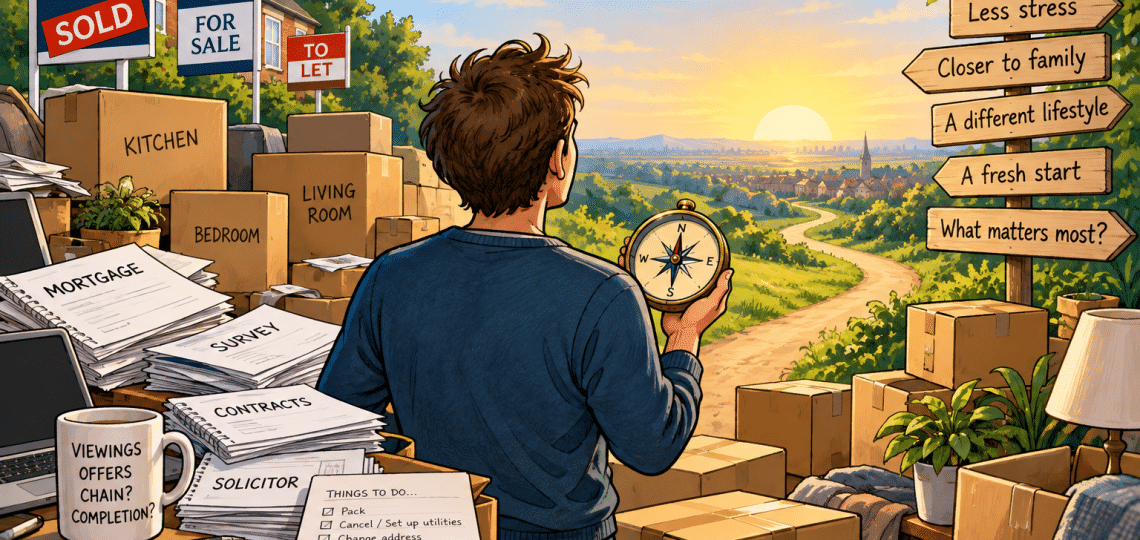
There are estate agents, viewings, offers, counteroffers, surveys, solicitors, mortgage arrangements, removal companies, packing, paperwork and an apparently endless stream of decisions.
There is also uncertainty.
Will our house sell? Are we asking the right price? Should we accept this offer? Is this the right house? Are we paying too much? What if the survey identifies something? What happens if someone in the chain pulls out?
And then there are the questions that don’t appear on any moving checklist.
Why are we actually moving?
What are we hoping will be different when we get there?
What really matters to us about where and how we live?
Which things are genuinely important, and which have simply found their way onto our list of requirements?
Having recently been through the process myself, I found myself reflecting on those questions.
And I realised something.
Coaching could have helped.
Not because I needed someone to tell me which house to buy.
Quite the opposite.
I could have benefited from someone who wasn’t trying to tell me anything at all.
Plenty of advice, but not necessarily space to think
One of the interesting things about moving house is the number of people involved.
Estate agents understand the property market. Mortgage advisers help navigate financing. Surveyors assess the property. Solicitors and conveyancers manage the legal process. Removal companies get your belongings from one place to another.
Friends and family also tend to have plenty of advice.
Everyone has a role to play.
But looking back, I can see there was something missing.
Someone whose only purpose was to help me think.
Someone without an interest in whether the transaction happened.
Someone who wasn’t emotionally invested in the decision.
Someone who could ask questions rather than provide answers.
That is where I think coaching could have made a difference.
And the more I’ve reflected on it, the more I’ve realised this probably isn’t unique to moving house.
During many of life’s significant transitions, we surround ourselves with people who can help us with the mechanics of change.
What we don’t necessarily have is someone helping us think about the change itself.
Moving house isn’t really about moving house
When we’re searching for a home, we naturally focus on the property.
How many bedrooms?
How big is the garden?
What’s the kitchen like?
Is there enough storage?
What’s the commute?
What are the local amenities?
All perfectly sensible questions.
But perhaps there’s another question that should come first:
What do I want my life to look like after I move?
That is a very different conversation.
A house is ultimately the setting in which part of our life will happen.
So perhaps we should understand the life we’re trying to create before deciding what that setting needs to look like.
For one person, moving might be about having more space for a growing family.
For another, it might mean reducing financial pressure.
It could be about being closer to family, shortening a commute, working from home, accessing the countryside, downsizing, preparing for retirement or simply beginning a new chapter.
Until we understand the purpose behind the move, it is surprisingly easy to become consumed by the properties themselves.
And that is exactly the sort of conversation coaching can create.
Understanding what really matters
Most of us start searching for property with a list.
Four bedrooms.
Garage.
Large garden.
Certain postcode.
Detached.
Walking distance to particular amenities.
There’s nothing wrong with having criteria. In fact, they’re essential.
But coaching might encourage us to go underneath them.
Why does that matter to you?
And then perhaps:
Why does that matter?
A requirement for a large garden might really represent a desire for tranquillity.
A particular location might represent belonging.
A home office might represent autonomy.
Downsizing might represent freedom.
Being close to family might represent connection.
These are not property features.
They are values.
Once we understand them, our choices can look very different.
Instead of asking only:
“Does this property meet our requirements?”
we can also ask:
“Does this choice support the life we want to live?”
Advice and coaching solve different problems
Reflecting on the experience made me realise there is an important distinction between needing an answer and needing space to find your own answer.
If I need to understand the legal implications of something discovered during a property search, I need expertise.
If I need to understand the financial implications of changing my mortgage, I need expertise.
If I need to understand the condition of a property, I need expertise.
But if I’m wrestling with whether the compromises I’m making still align with what I wanted from the move in the first place, another person’s answer may not be particularly helpful.
I need to understand my own.
Perhaps that’s where coaching has a distinctive role during periods of change.
It doesn’t provide another set of directions.
It helps us establish where we are, understand what matters, become clearer about where we’re trying to get to and make more conscious choices about the route between the two.
In other words, it helps us navigate.
When emotion enters the process
And then you walk into that house.
Suddenly the rational spreadsheet of property requirements becomes considerably less important.
You can imagine yourself living there.
Someone else is interested.
You don’t want to lose it.
At the other end of the transaction, perhaps your own house isn’t attracting the offers you expected.
Weeks pass.
Plans change.
Chains develop.
Surveys arrive.
Deadlines appear.
Emotion inevitably becomes part of the decision-making process.
That isn’t necessarily a bad thing. Buying a home is an emotional decision as well as a practical and financial one.
But emotion can make it harder to distinguish between what we know, what we assume and what we fear.
A coaching conversation could create space to explore questions such as:
What do you actually know?
What are you assuming?
What are you worried might happen?
What can you control?
What would change your decision?
Which compromise are you comfortable making — and which one would move you too far away from what matters?
The coach still doesn’t provide the answer.
They help make the thinking behind the answer clearer.
The compromises nobody puts on the property listing
Unless you have an unlimited budget, buying a house usually involves compromise.
Location or space?
Condition or potential?
Garden or convenience?
Character or efficiency?
More house or a smaller mortgage?
Move-in ready or renovation project?
The problem is not that compromises exist.
The challenge is knowing which compromises matter to you.
Without that clarity, it is easy to compromise on something fundamental while holding tightly to something that ultimately matters very little.
This is where values can become practical rather than abstract.
If we understand what really matters to us, our values become a compass against which compromises can be considered.
Not a set of rules.
A direction.
Then there’s the move itself
Finding the house isn’t the end of the process.
There is still the small matter of actually moving.
The volume of things competing for attention can become overwhelming surprisingly quickly.
Packing. Contracts. Utilities. Insurance. Broadband. Address changes. Removal companies. Furniture. Cleaning. Work commitments. Family commitments.
And inevitably something doesn’t go according to plan.
Coaching isn’t going to pack the boxes.
Unfortunately.
But it can help us decide where to focus our energy.
What needs attention now?
What can wait?
What can be delegated?
What is within my control?
What am I spending energy worrying about that I cannot influence?
Those questions extend well beyond moving house.
They are questions about how we navigate change.
Perhaps that’s what moving house really is
Looking back on my own experience, I’ve realised that buying and selling property is only part of what happens when we move.
We’re navigating a transition.
We’re leaving somewhere that has been part of our lives and moving towards something new.
Sometimes that transition is exciting.
Sometimes it’s stressful.
Usually it’s both.
And transitions create questions that professional expertise alone cannot necessarily answer.
A solicitor can advise on legal matters.
A surveyor can assess the condition of a property.
A mortgage adviser can help us understand financing options.
An estate agent can help navigate the transaction.
All of that expertise is valuable.
But none of those experts can ultimately answer:
What matters most to me?
What am I trying to move towards?
What am I prepared to compromise?
What does the next stage of my life look like?
Those answers have to come from us.
Moving towards the next horizon
Perhaps the biggest thing I’ve taken from moving house isn’t actually about property.
It’s about how easily, during a significant transition, the practicalities can take over. There is always another decision to make, another problem to solve and another item to cross off the list. Yet beneath all that activity sits a more important question: what am I actually moving towards?
In our case, the destination happened to be a new home. But the same question can surface whenever life begins to shift — changing career, taking on a new role, approaching retirement, reconsidering our priorities or simply recognising that something needs to change.
We may not always need someone to give us an answer. Sometimes what we need most is the space to step away from the immediate decisions, reconnect with what matters and see the bigger picture more clearly.
That, for me, is where coaching can be particularly valuable during times of transition.
My house move involved plenty of conversations about where I was going. Looking back, I think the more useful conversation might have started somewhere else:
What am I moving towards?
Perhaps that is a question worth asking whenever we find ourselves approaching a new horizon.