“You don’t need another hour in your day — you need to reclaim the attention that’s already yours.”
If you’ve ever said:
- “I’ll do it when things calm down.”
- “I just don’t have enough time.”
- “I’m too busy to focus on my goals.”
You’re certainly not alone. Time has become the world’s favourite excuse.
Yet every one of us receives exactly the same 24 hours each day.
Some people build businesses, write books, train for marathons, learn new skills and still spend meaningful time with family. Others reach Friday wondering where the week disappeared.
The difference isn’t usually time.
It’s how attention is managed.
At Novista Coaching, we believe that lasting personal growth isn’t about cramming more into your diary. It’s about becoming intentional with your attention, understanding the habits that steal your focus, and creating space for the things that genuinely move your life forward.
Because success isn’t measured by how busy you are. It’s measured by whether you’re making meaningful progress towards the horizon you’ve chosen.
Why Most Time Management Advice Doesn’t Work
Search online for time management tips and you’ll find endless advice:
- Wake up at 5 a.m.
- Buy another planner.
- Colour-code your calendar.
- Download a new productivity app.
- Make longer to-do lists.
These ideas aren’t necessarily bad. But they often treat the symptom instead of the cause.
The real challenge isn’t scheduling.
It’s attention.
We live in what researchers call the attention economy. Every notification, email, advertisement and social media feed has been carefully designed to compete for your focus. Your attention is valuable, and countless companies invest billions of pounds trying to capture it.
If you don’t intentionally manage your attention, someone else will.
Understanding Your Productivity Triggers
Before you can improve your productivity, you need to understand why you become distracted.
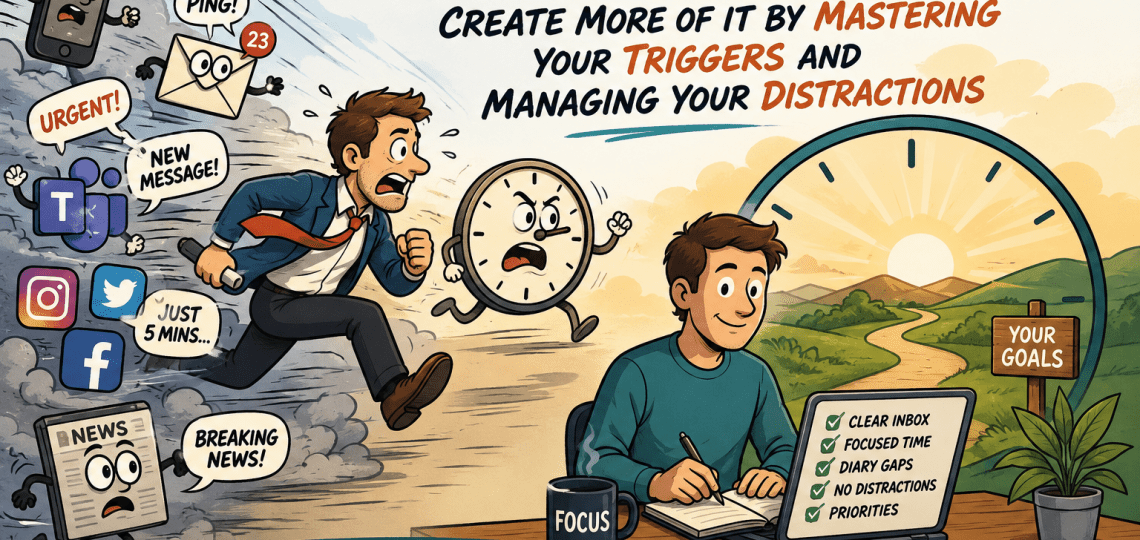
Many people assume distractions happen randomly. They don’t. Almost every distraction begins with a trigger.
For example:
You begin writing an important report. After five minutes you feel stuck. Without thinking, you open Outlook.
Then Teams.
Then LinkedIn.
Then your phone.
Twenty minutes disappear.
Nothing meaningful has been completed.
The trigger wasn’t your phone.
The trigger was discomfort.
Common productivity triggers include:
- Feeling overwhelmed
- Fear of making mistakes
- Perfectionism
- Boredom
- Stress
- Decision fatigue
- Lack of clarity
- Fear of failure
- Fear of success
- Fear of missing out (FOMO)
Recognising these triggers is transformative.
Instead of saying:
“I’m terrible at concentrating.”
You begin asking:
“What made me reach for my phone just then?”
Awareness creates choice. Choice creates change.
The Hidden Cost of Constant Distraction
Imagine trying to read a book while somebody interrupted you every six minutes. It would be exhausting.
Yet that’s exactly how many professionals work every day.
Notifications interrupt meetings.
Emails interrupt deep thinking.
Teams messages interrupt writing.
Phones interrupt conversations.
Each interruption seems insignificant. Collectively, they’re devastating.
Research consistently shows that switching between tasks carries a mental cost. It can take several minutes to fully regain concentration after an interruption, particularly when you’re engaged in complex thinking.
This is why people often spend entire days being busy while achieving very little.
Activity isn’t achievement. Responsiveness isn’t productivity.
Progress comes from sustained attention.
Stop Reacting. Start Creating.
Most people begin their working day by opening email. Within minutes they’re working on everyone else’s priorities.
Their day becomes reactive instead of intentional.
Try reversing the order. Before opening Outlook, ask yourself:
“What is the single most important thing I could complete today?”
Do that first.
Protect it.
Finish it.
Everything else becomes easier once meaningful progress has already been made.
Master Inbox Zero — Without Becoming a Slave to Your Inbox
One productivity approach that continues to influence knowledge workers is Inbox Zero, popularised by productivity expert Ian Charnas as a practical decision-making framework.
The philosophy isn’t about obsessively maintaining an empty inbox. It’s about avoiding decision fatigue.
Every email should lead to a decision:
- Delete it.
- Archive it.
- Reply immediately if it only takes a couple of minutes.
- Delegate it.
- Schedule time to deal with it properly.
What shouldn’t happen is allowing hundreds of unread emails to become a second to-do list.
Your inbox is a communication channel. It isn’t your productivity system.
Instead of checking emails every few minutes, designate two or three specific times each day for email processing.
You’ll probably discover something surprising:
Very little genuinely required an immediate response.
Use the Pomodoro Technique to Build Focus
Large goals often fail because they feel overwhelming. Twenty-five minutes doesn’t.
The Pomodoro Technique remains one of the simplest and most effective productivity methods ever created.
Here’s how it works:
- Choose one task.
- Set a timer for 25 minutes.
- Work without interruption.
- Take a five-minute break.
- Repeat four times.
- Take a longer break.
The beauty lies in its simplicity. Anyone can stay focused for twenty-five minutes.
Knowing a break is coming also makes distractions easier to resist. Over time, these focused sessions build remarkable momentum.
A book isn’t written in one sitting.It’s written through hundreds of uninterrupted periods
Diary Gapping: The Productivity Habit Nobody Talks About
Look at the diary of many professionals.
Meeting after meeting.
No thinking time.
No preparation time.
No recovery time.
No creativity.
It’s no surprise people feel overwhelmed. One of the most valuable habits you can develop is diary gapping.
Unlike diary blocking—which schedules work into dedicated time slots—diary gapping deliberately leaves strategic space between commitments.
These protected gaps become opportunities to:
- Complete important work
- Think strategically
- Reflect
- Solve problems
- Prepare for meetings
- Learn
- Recover mentally
The irony is simple. By scheduling less, you often achieve far more.
Space creates clarity. Clarity improves decision-making.
Better decisions create better results.
Eliminate Digital Noise
Every notification competes with your goals.
Ask yourself honestly:
Do you really need instant alerts for:
- Every email?
- Every Teams message?
- Every LinkedIn notification?
- Every news headline?
- Every shopping offer?
- Every app update?
Probably not.
Turn off everything that doesn’t genuinely deserve your immediate attention.
Better still:
Schedule times when you check communication platforms rather than allowing them to interrupt your day.
Technology should serve you. Not the other way around.
Build a Personal Focus Ritual
High performers rarely rely on motivation. They rely on routines.
Create a simple ritual that signals to your brain:
“It’s time to focus.”
For example:
- Make a coffee.
- Clear your desk.
- Close unnecessary browser tabs.
- Put your phone on Do Not Disturb.
- Turn off Teams notifications.
- Close your email.
- Start a Pomodoro timer.
- Write down today’s single priority.
- Begin.
Repeat this every day.
Eventually your brain associates this routine with deep concentration.
Focus becomes easier because you’ve trained your environment to support it.
Your Environment Shapes Your Behaviour
James Clear famously wrote:
“You do not rise to the level of your goals. You fall to the level of your systems.”
The same applies to productivity.
If your phone sits beside your keyboard… You’ll pick it up.
If Outlook remains open… You’ll check it.
If Teams constantly flashes… You’ll respond.
Design your environment to support the behaviour you want.
Remove friction from productive habits. Add friction to distracting ones.
Simple examples include:
- Keeping your phone in another room.
- Using website blockers during focus sessions.
- Wearing headphones as a visual “do not disturb” signal.
- Closing unnecessary applications.
- Working full-screen on one task.
Small environmental changes produce disproportionately large improvements.
Focus on Progress, Not Perfection
Perfectionism is often disguised as productivity.
You tell yourself you’re “getting it right.” In reality, you’re avoiding finishing.
Progress beats perfection every time.
Your first draft won’t be perfect.
Your first presentation won’t be perfect.
Your first coaching session won’t be perfect.
Neither will your first business idea.
Done creates learning.
Perfection creates delay.
Align Your Time with Your Values
One of the biggest mistakes people make isn’t poor time management. It’s spending time on goals that aren’t truly theirs.
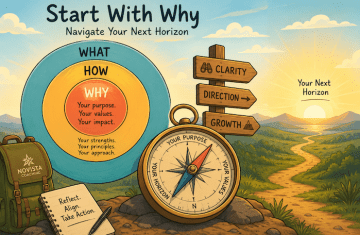
At Novista Coaching, we help clients discover their core values, because values act as a compass for decision-making.
When your diary reflects your values:
- Decisions become easier.
- Motivation becomes more sustainable.
- Boundaries become clearer.
- Priorities become obvious.
Ask yourself:
- Does my calendar reflect what’s important to me?
- Am I investing time where I say my priorities lie?
- Would someone looking at my diary understand my values?
Your diary tells the truth.
Small Improvements Compound Over Time
Imagine reclaiming just one focused hour each working day.
That becomes:
- 5 hours each week.
- Around 250 hours each year.
- More than six additional working weeks.
What could you achieve?
You could:
- Gain a professional qualification.
- Build a side business.
- Improve your health.
- Learn a language.
- Write a book.
- Develop stronger relationships.
- Finally pursue the goals you’ve postponed.
You don’t need more time.
You need fewer distractions.
A Practical Daily Focus Framework
Try this tomorrow.
Morning
- Don’t open email immediately.
- Identify your Most Important Task.
- Complete one Pomodoro before checking messages.
Mid-Morning
- Process your inbox using Inbox Zero principles.
- Respond, delegate, archive or schedule.
Afternoon
- Protect diary gaps for deep work.
- Silence unnecessary notifications.
- Batch communication tasks.
End of Day
- Review your progress.
- Identify tomorrow’s priority.
- Leave work knowing where you’ll begin next.
Simple.
Repeatable.
Sustainable.
Final Thoughts: Productivity Is About Living Intentionally
The world’s busiest people are not necessarily the most fulfilled.
True productivity isn’t about squeezing every possible task into your day. It’s about ensuring your time reflects the life you’re trying to build.
Every distraction you remove creates room for something meaningful.
Every focused hour moves you closer to your goals.
Every intentional decision strengthens the habits that shape your future.
At Novista Coaching, we believe your life shouldn’t be driven by notifications, meetings or endless to-do lists. It should be guided by your values, your purpose and the horizon you want to reach.
The journey towards your next horizon doesn’t begin with finding more time.
It begins with protecting the time you already have.
Ready to Navigate Your Next Horizon?
If you’re feeling overwhelmed, constantly busy yet struggling to make meaningful progress, coaching can help you reconnect your daily actions with your long-term ambitions.
At Novista Coaching, we help individuals and leaders:
- Discover their core values and purpose.
- Clarify personal and professional goals.
- Build sustainable productivity habits.
- Develop resilience and self-discipline.
- Create practical plans that turn ambition into achievement.
- Stay accountable while making lasting change.
Whether you’re looking to progress your career, improve your work-life balance, lead more effectively or simply regain control of your time, we’re here to help you create a clear path forward.
Book a discovery conversation today and start navigating your next horizon with confidence.